

Ovarian cancer rates are falling in wealthy nations—but rising elsewhere, global study finds
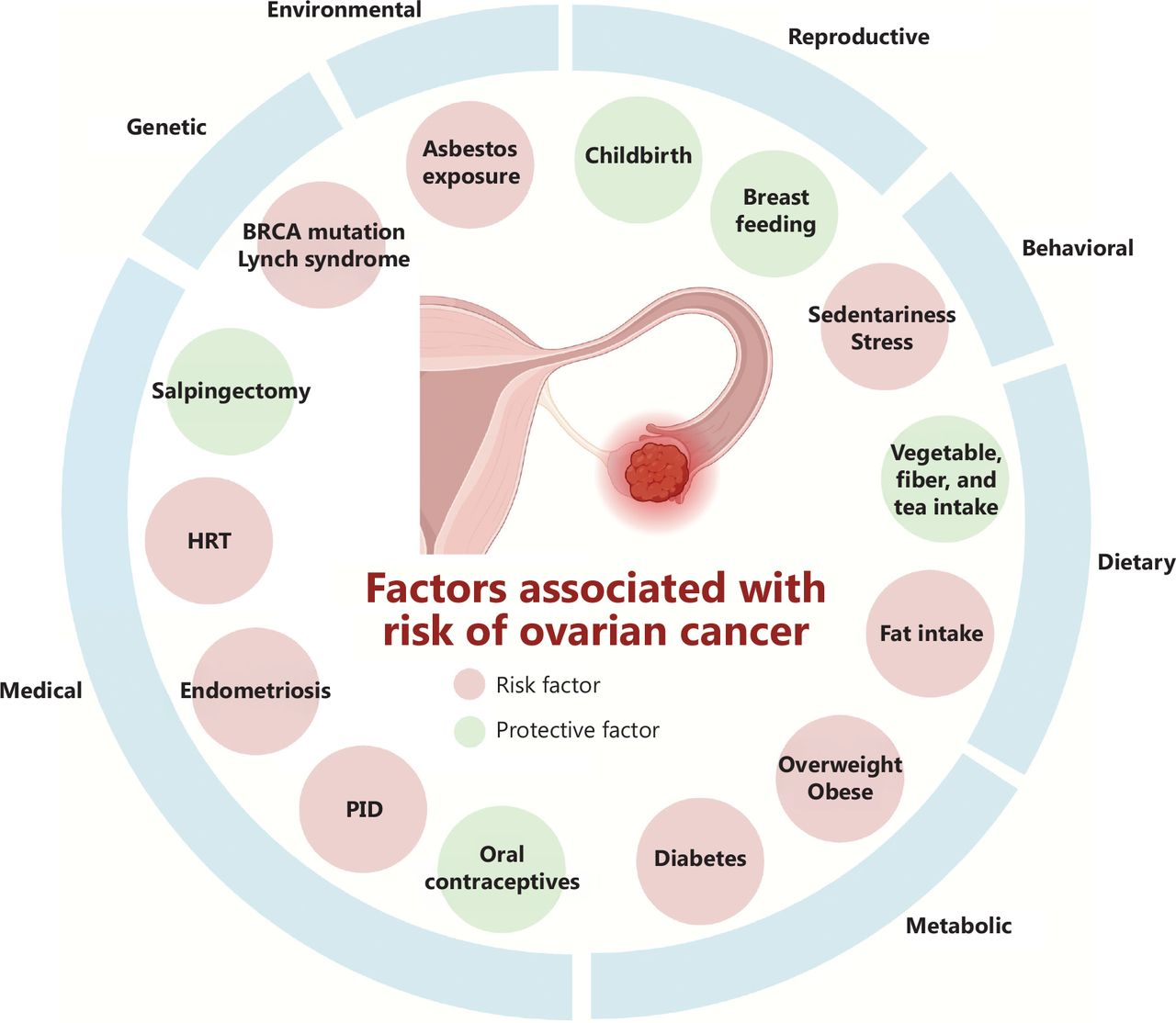
Summary of risk factors for ovarian cancer. This schematic summarizes and categorizes a spectrum of factors linked to ovarian cancer risk, distinguishing between factors that increase risk and factors that confer protection. The factors are organized into
GA, UNITED STATES, August 28, 2026 /EINPresswire.com/ -- Ovarian cancer ranks as the eighth most common cancer and eighth leading cause of cancer death among women globally, with over 324,000 new cases and nearly 207,000 deaths estimated in 2022. Despite therapeutic advances, five‑year survival remains below 50% in most countries, and no screening strategy has been shown to reduce mortality in average‑risk women. A new comprehensive review synthesises global epidemiologic data from GLOBOCAN, the Global Burden of Disease Study and CONCORD‑3, mapping where the disease is declining, where it is rising, and which modifiable factors drive risk. The findings provide a clear evidence base for public health strategies tailored to regional and individual risk profiles.
Ovarian cancer is notoriously diagnosed at advanced stages because early disease is often asymptomatic, and current screening—serum CA‑125 plus transvaginal ultrasound—has failed to reduce mortality in average‑risk populations in major trials such as PLCO and UKCTOCS. While high‑income countries including the United States, Austria and Norway have seen declining incidence rates, parts of Asia and Africa are experiencing increases. Survival has improved modestly in some nations but remains strikingly low in others, with rates below 20% in India. Based on these challenges, a thorough examination of global trends, regional disparities and actionable risk factors is urgently needed to inform more effective prevention and early‑detection strategies.
A team from the National Cancer Center of China and Yale University has published a comprehensive review in Cancer Biology & Medicine (2026). The study, conducted by researchers from the Department of Gynecological Oncology at the Cancer Hospital Chinese Academy of Medical Sciences in collaboration with Yale School of Public Health, synthesises data from over 50 meta‑analyses and large population‑based studies. The review covers incidence and mortality trends, disability‑adjusted life years, and a wide spectrum of risk factors—from reproductive history and diet to genetics and occupational exposures.
The global picture is one of divergence. From 1990 to 2021, the age‑standardised incidence rate of ovarian cancer fell from 7.22 to 6.71 per 100,000, while mortality declined from 4.73 to 4.06 per 100,000. Yet these averages mask stark regional contrasts: Eastern Europe has the highest incidence at 11.0 per 100,000, whereas Middle Africa’s rate is only 4.3 per 100,000. The review identifies a broad spectrum of modifiable risk factors. Each additional birth reduces risk by about 6%, and every 12 months of breastfeeding lowers it by roughly 10%. Conversely, pro‑inflammatory diets (measured by the Dietary Inflammatory Index) increase risk by 42%, while obesity is linked to serous borderline, endometrioid and mucinous subtypes. Prolonged sitting—10 or more hours per week—raises risk by 25% to 40%. Oral contraceptives remain strongly protective (about 27% reduction with ever‑use), whereas menopausal hormone therapy increases risk, particularly for serous and endometrioid cancers. For high‑risk women carrying BRCA1 or BRCA2 mutations, risk‑reducing salpingo‑oophorectomy (RRSO) cuts risk by 80%–97%, and remains the gold standard. The authors also highlight emerging disparities: black patients have a 25% lower treatment adherence and 18% higher mortality than white patients, underscoring the role of socioeconomic and healthcare‑access factors.
“The data show that ovarian cancer is not one disease with one trajectory—it behaves differently across regions, populations and histologic subtypes,” the authors said. “While we cannot yet screen effectively for the general population, we have a solid grasp of many modifiable risk factors. That means prevention is achievable, but it demands tailored approaches: promoting breastfeeding and physical activity, managing obesity and diabetes, and ensuring access to genetic testing and risk‑reducing surgery for high‑risk women.” They stressed that the widening gap between high‑ and low‑resource settings calls for urgent policy attention, as incidence is rising in parts of Asia and Africa where preventive interventions remain scarce.
For clinicians, the review reinforces the importance of counselling patients on reproductive choices, diet and physical activity as part of cancer risk reduction. For health systems, the data pinpoint where genetic testing and preventive surgery should be concentrated. The authors also note that emerging technologies—including artificial intelligence‑enabled screening tools and novel biomarkers such as DNA methylation and circulating tumour DNA—offer hope for earlier detection, but they caution that rigorous prospective trials are needed before adoption. With ovarian cancer cases projected to increase by nearly 47% by 2050, the review underscores that prevention, not just better treatment, must become a global priority. Public health campaigns should target modifiable lifestyle factors while expanding access to surgical prevention for genetically predisposed women.
References
DOI
10.20892/j.issn.2095-3941.2025.0619
Original Source URL
https://doi.org/10.20892/j.issn.2095-3941.2025.0619
Funding information
This study was supported by Beijing Natural Science Foundation (Grant No. Z240004).
Lucy Wang
BioDesign Research
email us here
Legal Disclaimer:
EIN Presswire provides this news content "as is" without warranty of any kind. We do not accept any responsibility or liability for the accuracy, content, images, videos, licenses, completeness, legality, or reliability of the information contained in this article. If you have any complaints or copyright issues related to this article, kindly contact the author above.
