

Automated Material Handling Market Growth Accelerates at 13.0% CAGR Through 2035
Automated Material Handling Market
Automated Material Handling (AMH) Market Size, Share and Research Report By Component (Software, Services), Operation (Packaging & Distribution, Storage)
Automated Material Handling Market is growing rapidly, driven by increasing warehouse automation, e-commerce expansion, and demand for efficient logistics operations.”
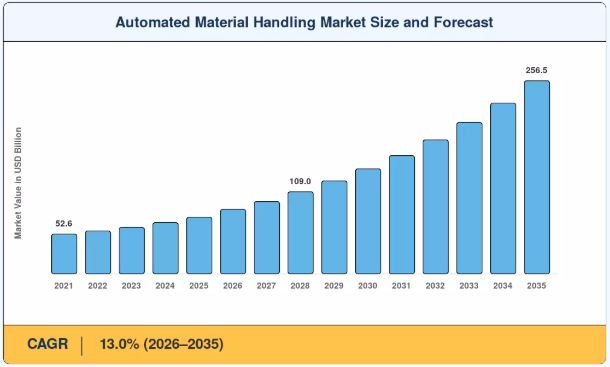
TOKYO, TOKYO, JAPAN, June 29, 2026 /EINPresswire.com/ -- The Global Automated Material Handling market was valued at USD 75.6 billion in 2025 and is projected to grow from USD 85.4 billion in 2026 to USD 256.5 billion by 2035, exhibiting a compound annual growth rate (CAGR) of 13.0% during the forecast period. — Market Research Future (MRFR)
Automated material handling encompassing automated guided vehicles (AGVs), autonomous mobile robots (AMRs), automated storage and retrieval systems (AS/RS), robotic systems, conveyors, and warehouse management software has become the operational backbone of modern supply chains across e-commerce, automotive, semiconductor, pharmaceutical, and food and beverage industries.
The relentless expansion of global e-commercewith online retail sales surpassing USD 6 trillion in 2024 is generating acute demand for faster, more accurate, and more scalable fulfillment infrastructure than manual operations can provide.
Two structural forces anchor the automated material handling market’s decade-long growth trajectory: persistent global labor shortages compressing manufacturing and logistics margins, and the accelerating integration of artificial intelligence and robotics into warehouse orchestration platforms.
The US Bureau of Labor Statistics reported 560,000+ unfilled manufacturing positions in early 2025, while Europe’s logistics sector faces comparable workforce deficits, making AMH automation increasingly non-discretionary. Amazon’s 3.5 million square-foot Colorado fulfillment center operating with 5,000 robots — and Walmart’s five high-tech perishable distribution centers that doubled throughput while creating 2,000 jobs collectively exemplify the scale of automated material handling investment transforming North American logistics infrastructure.
Get Full PDF Sample Copy of Report: (Including Full TOC, List of Tables & Figures, Chart) @
https://www.marketresearchfuture.com/sample_request/1029
➤ How Significant Is the Automated Material Handling Market’s Growth?
The automated material handling market’s trajectory from USD 75.6 billion in 2025 to a projected USD 256.5 billion by 2035 represents nearly a three-fold expansion, reflecting the structural shift from labor-intensive manual warehouse operations to software-orchestrated, robot-dense fulfillment ecosystems across every major industry vertical. This 13.0% CAGR makes AMH one of the most sustained high-growth categories in the broader industrial automation market.
The manufacturing application segment is projected to reach USD 45.0 billion by 2035, representing the market’s largest application category, while the order fulfillment segment is forecast to reach USD 35.0 billion reflecting the e-commerce sector’s outsized contribution to warehouse automation capital investment.
The robotics technology segment is expected to reach USD 45.0 billion by 2035, validating the market-wide shift from fixed conveyor-centric architectures toward flexible, AI-orchestrated autonomous mobile robot fleets. Real-time data utilization is becoming essential for optimizing warehouse management and order fulfillment processes, with AMH software platforms enabling dynamic task allocation, predictive maintenance, and multi-robot fleet coordination that collectively drive measurable throughput improvements of 40–60% over manual baseline operations.
➤ What Does the Future Hold for the Automated Material Handling Market?
The integration of robotics and artificial intelligence is transforming operational efficiencies across the automated material handling market at an accelerating pace. AI-powered warehouse management systems — including Honeywell Intelligrated’s new AI-driven platform launched in October 2025 that integrates seamlessly with existing infrastructure to improve inventory accuracy and reduce operational costs are enabling real-time dynamic task allocation across hundreds of concurrent AMR and conveyor assets.
Dematic’s September 2025 launch of next-generation robotic order fulfillment solutions, and Daifuku’s strategic partnership with Microsoft to integrate Azure cloud analytics for real-time monitoring and predictive maintenance, exemplify the industry-wide push toward AI-native warehouse intelligence that is reshaping the competitive landscape.
Sustainability initiatives are increasingly influencing material handling investment decisions, particularly across North America and Europe. AutoStore systems consuming 13,600 kWh annually while quadrupling storage density are enabling facilities to dramatically shrink their footprint and energy bills simultaneously.
Dematic reduced its own greenhouse-gas emissions by 14.8% using high-efficiency motors that lowered energy draw by 25%, while solar-integrated warehouses enabling daylight-hour operations on renewable power are emerging as a procurement differentiator in ESG-conscious enterprise procurement programs. Europe’s Corporate Sustainability Reporting Directive is compelling firms to factor carbon metrics into automation investment decisions, accelerating the adoption of energy-efficient AMH systems across the region’s logistics network.
Robotics-as-a-Service (RaaS) business models are dismantling the capital barrier that has historically limited automated material handling adoption to large enterprises. Comprehensive warehouse automation requiring USD 2–4 million in upfront capital has been a significant hurdle for mid-market operators, but RaaS models including BALYO’s performance-based AMR subscription offering promising 30% opex savings are enabling smaller operators to access automated material handling capabilities without major capital commitments.
The emergence of humanoid robot platforms through partnerships including Foxconn–NVIDIA and Jabil–Apptronik’s Apollo collaboration signals the longer-term disruption potential of general-purpose robotic systems that could dramatically expand the addressable task universe for warehouse automation beyond the structured, repetitive workflows that define current AMH deployments.
➤ Who Are the Key Players in the Automated Material Handling Market?
The automated material handling market is served by a concentrated group of global system integrators with end-to-end warehouse automation capabilities alongside a dynamic ecosystem of specialist robotics and software platform providers. MRFR identifies the following key participants:
Dematic (a KION Group company, US) — a global leader in intelligent supply chain automation, providing end-to-end automated material handling solutions including AS/RS, conveyor systems, AGVs, and AI-powered warehouse management software, with September 2025 robotic order fulfillment solutions extending its capabilities across e-commerce and retail distribution.
Honeywell Intelligrated (US) — a major provider of automated material handling systems and software for fulfillment and distribution, offering conveyor and sortation systems, robotic palletizing, and the October 2025-launched AI-driven warehouse management platform enabling inventory accuracy improvements without significant additional capital investment.
KION Group AG (Germany) — a global leader in industrial trucks and supply chain solutions encompassing both the Dematic automation brand and the Linde and STILL forklift divisions, providing integrated automated material handling ecosystems from warehouse entry to final-mile delivery.
Mitsubishi Logisnext Co., Ltd. / MHI (Japan) — a major industrial vehicle and logistics automation provider offering AGVs, automated forklifts, and integrated warehouse automation systems through its comprehensive Logisnext portfolio serving manufacturing, logistics, and cold-chain applications.
Siemens AG (Germany) — a global industrial automation leader providing advanced AS/RS, intelligent software platforms optimizing material flow, and integrated warehouse automation systems with superior digital twin and IIoT connectivity capabilities for demanding manufacturing and distribution applications.
Daifuku Co., Ltd. (Japan) — the world’s largest material handling systems provider, offering comprehensive automation solutions for automotive manufacturing, airport logistics, semiconductor cleanrooms, and distribution centers, with a Q3 2024 Microsoft Azure partnership enhancing real-time monitoring and predictive maintenance capabilities across its global installed base.
Swisslog Holding AG (Switzerland, a KUKA company) — an automated intralogistics specialist providing robotic picking systems, automated storage solutions, and WMS software platforms for healthcare, food & beverage, and retail distribution, with a Q4 2024 contract to fully automate a major European retailer’s distribution center demonstrating its large-scale integration capabilities.
Toyota Industries Corporation (Japan) — a comprehensive material handling and automation provider offering AGVs, automated forklifts, and integrated logistics systems, with a Q1 2025 acquisition of a US-based robotics startup extending its autonomous material handling capabilities into next-generation AMR platform development.
Vanderlande Industries B.V. (Netherlands, a Toyota Industries company) — a global market leader in automated material handling systems for airports, parcel distribution, and warehousing, providing baggage handling systems, parcel sorting automation, and integrated warehouse automation for major retailers and logistics service providers.
Competitive dynamics are increasingly shaped by the transition from pure hardware toward AI-centric software orchestration platforms, strategic acquisitions to expand robotics portfolios, and the race to develop modular, scalable AMH architectures that accommodate the flexible, omnichannel fulfillment requirements of modern retail and e-commerce operations.
➤ What Are the Emerging Trends in the Automated Material Handling Market?
Several transformational trends are redefining the automated material handling market’s evolution through 2035:
AI & Robotics Integration Driving Operational Intelligence: AI-powered warehouse orchestration platforms are enabling real-time dynamic task allocation across multi-robot fleets, predictive maintenance scheduling, and intelligent inventory positioning that collectively deliver 40–60% throughput improvements over manual baseline operations. The shift from fixed automation to AI-adaptive systems is the defining competitive battleground across the market.
E-Commerce Fulfillment Infrastructure Expansion: Surging online retail sales exceeding USD 6 trillion annually are compelling retailers and logistics service providers to invest in automated order fulfillment infrastructure capable of processing thousands of orders per hour with same-day delivery accuracy. Amazon’s 5,000-robot Colorado facility and Walmart’s throughput-doubling perishable distribution centers are templates being replicated globally.
Robotics-as-a-Service Democratization: Performance-based RaaS models are lowering the USD 2–4 million capital barrier that has restricted AMH adoption to large enterprises, enabling mid-market warehouses, smaller 3PLs, and regional distribution operators to access automated material handling capabilities under opex-based subscription contracts with guaranteed performance metrics.
Sustainability & Energy-Efficient Automation: ESG mandates and corporate sustainability commitments are accelerating procurement of energy-efficient AMH systems, with AutoStore’s quadrupled storage density, Dematic’s 25% energy draw reduction, and solar-integrated warehouse operations establishing sustainability performance as a primary vendor evaluation criterion alongside throughput and accuracy metrics.
Humanoid & Next-Generation AMR Development: Strategic collaborations between Foxconn and NVIDIA for humanoid robot factory deployment, Jabil and Apptronik for Apollo humanoid production scaling, and DHL’s 1,000-robot Boston Dynamics partnership signal the emerging role of general-purpose robotic systems in expanding the addressable task universe of warehouse automation beyond current structured workflow limitations.
Digital Twin & Predictive Maintenance Adoption: The integration of digital twin simulation and IoT-connected predictive maintenance platforms — exemplified by Daifuku’s Microsoft Azure partnership for real-time monitoring — is enabling warehouse operators to optimize layout configurations, simulate throughput scenarios, and predict equipment failures before they disrupt operations, creating new premium service revenue streams for AMH system integrators.
Get access to the full description of the report @
https://www.marketresearchfuture.com/reports/automated-material-handling-market-1029
➤ How Is the Automated Material Handling Market Segmented?
The automated material handling market report provides a comprehensive segmentation framework:
By Component: Software, Services
By Operation: Packaging & Distribution, Storage & Transportation, Waste Management, Assembly
By Equipment: Automated Guided Vehicles (AGVs), Robotic Systems, Conveyors, Automated Cranes, Automated Storage & Retrieval Systems (AS/RS)
By Application: E-Commerce, Food & Beverages, Automotive, Semiconductor & Electronics, Healthcare, Aviation, Chemicals
By Region: North America, Europe, Asia-Pacific, Rest of the World
➤ What Are the Regional Insights from the Automated Material Handling Market?
Asia-Pacific dominates the global automated material handling market, with the region commanding approximately 44% of worldwide revenue in 2024, driven by Japan’s world-leading industrial robot density, China’s smart manufacturing directives under Made in China 2025, and rapidly expanding e-commerce fulfillment infrastructure across South Korea, India, and Southeast Asia. Daifuku’s new Indian manufacturing plant and JD Logistics’ high-tech Melbourne hub exemplify the scale of regional AMH investment. China’s domestic AS/RS and conveyor manufacturing base, combined with government subsidies for smart factory automation, is driving both domestic adoption and increasingly competitive export offerings that are reshaping global market dynamics.
North America is the second-largest regional market and the primary AMH innovation hub, featuring large-scale robotics deployments such as Amazon’s 3.5 million square-foot Colorado fulfillment center housing 5,000 robots and Walmart’s five high-tech perishable distribution centers that doubled throughput. Sustainability mandates are spurring energy-efficient AMH retrofits across logistics networks, while persistent labor shortages of 560,000+ unfilled manufacturing and warehousing positions are creating structural, non-cyclical demand for warehouse automation that is reinforced by the US Inflation Reduction Act’s domestic manufacturing investment incentives.
Europe holds the third-largest regional share, with AMH adoption focused on ESG-compliant solutions and Industry 4.0 convergence. REWE’s Magdeburg automated distribution facility processing 286,000 packages daily under strict environmental standards, and Dematic’s partnership with Groupe Robert pioneering fully automated cold storage in Quebec, showcase the sophisticated application environments driving European procurement. Germany’s automotive manufacturing base — the world’s most advanced in terms of robot density — and France’s major retail distribution networks are the primary demand engines, with the Corporate Sustainability Reporting Directive compelling carbon-metric integration into automation investment decisions.
The Rest of the World segment encompassing South America, the Middle East, and Africa represents an emerging growth frontier for the automated material handling market, driven by expanding e-commerce infrastructure in Brazil and Mexico, smart warehouse investment in the Gulf Cooperation Council states, and growing food and beverage manufacturing automation across Southeast Africa. While these regions currently represent a smaller share of global revenue, rising labor costs, expanding logistics infrastructure, and growing foreign direct investment in manufacturing and distribution capacity are expected to support above-average AMH adoption growth rates through 2035.
➤➤➤ Regional & Country-Level Reports by Market Research Future:
Automated Material Handling Market -
https://www.marketresearchfuture.com/reports/us-automated-material-handling-market-16786
➤➤➤ Industry Analysis Reports by Market Research Future:
Credit Intermediation Market
https://www.marketresearchfuture.com/reports/credit-intermediation-market-23877
Open Banking Systems Market
https://www.marketresearchfuture.com/reports/open-banking-systems-market-23891
Led Modular Display Market
https://www.marketresearchfuture.com/reports/led-modular-display-market-23899
Charge Card Market
https://www.marketresearchfuture.com/reports/charge-card-market-23906
Aerospace Insurance Market
https://www.marketresearchfuture.com/reports/aerospace-insurance-market-23909
Handwriting Digital Pen Market
https://www.marketresearchfuture.com/reports/handwriting-digital-pen-market-23914
Merchant Banking Services Market
https://www.marketresearchfuture.com/reports/merchant-banking-services-market-23963
Gap Insurance Market
https://www.marketresearchfuture.com/reports/gap-insurance-market-23997
Decentralized Insurance Market
https://www.marketresearchfuture.com/reports/decentralized-insurance-market-24081
Telecommunications Insurance Market
https://www.marketresearchfuture.com/reports/telecommunications-insurance-market-24091
Sagar Kadam
Market Research Future
+ + +1 628-258-0071
email us here
Visit us on social media:
LinkedIn
Facebook
YouTube
X
Legal Disclaimer:
EIN Presswire provides this news content "as is" without warranty of any kind. We do not accept any responsibility or liability for the accuracy, content, images, videos, licenses, completeness, legality, or reliability of the information contained in this article. If you have any complaints or copyright issues related to this article, kindly contact the author above.
